



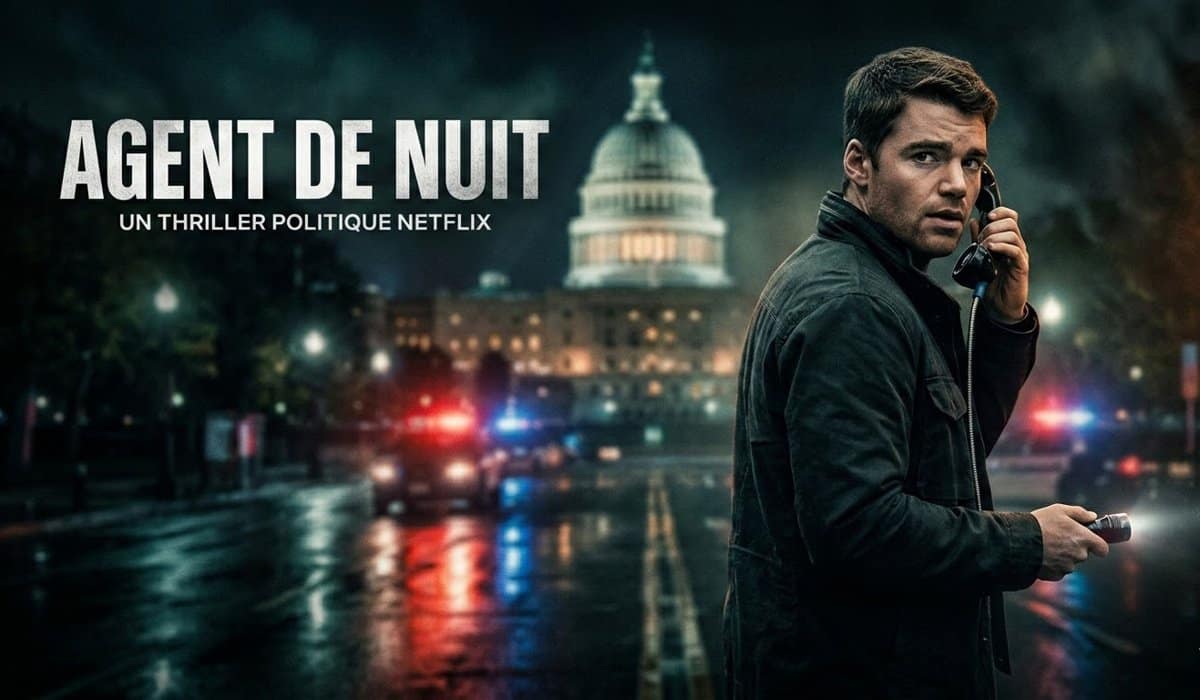

Presentation
Released on Netflix in March 2023, The Night Agent quickly established itself as one of the platform’s most successful political thrillers in recent years. Created by Shawn Ryan and adapted from Matthew Quirk’s novel, the series blends high-stakes espionage with a grounded, character-driven narrative. Within days of its release, it climbed into Netflix’s global Top 10 and maintained strong audience engagement, leading to rapid renewal for subsequent seasons.
Positioned somewhere between classic White House dramas and modern conspiracy thrillers, the show capitalizes on tension, urgency, and the vulnerability of its protagonist. As of now, the series spans multiple seasons, with each installment expanding the scope of the conspiracy while deepening character arcs. Its success lies in its accessibility: it doesn’t reinvent the genre, but it executes familiar tropes with efficiency and intensity.
Synopsis
The story centers on Peter Sutherland, a low-level FBI agent assigned to a seemingly mundane role in the White House basement. His job is to monitor an emergency phone line that almost never rings. When it finally does, everything changes. The call pulls him into a sprawling conspiracy that reaches the highest levels of the U.S. government.
Alongside Rose Larkin, a tech entrepreneur caught in the crossfire, Peter must navigate a web of betrayal, hidden agendas, and political intrigue. The first season focuses on uncovering the immediate threat while establishing the broader conspiracy network. Subsequent seasons build on this foundation, expanding the geopolitical stakes and introducing new adversaries, alliances, and moral dilemmas.
The series maintains a constant sense of urgency. Each episode pushes the narrative forward with minimal downtime, balancing investigative sequences with action-driven set pieces. While the structure remains relatively traditional for the genre, the pacing ensures sustained engagement.
Critical Analysis
One of the defining strengths of The Night Agent is its pacing. The series adopts a “no filler” philosophy, where nearly every scene serves the plot. This approach keeps viewers engaged but occasionally sacrifices deeper exploration of secondary characters. The tension is consistently maintained through tight editing and well-timed narrative reveals.
The central character, Peter Sutherland, is portrayed as competent yet fallible. This balance makes him relatable, especially in contrast to the often invincible archetypes found in similar shows. His evolution from a background operative to a central figure in national security forms the emotional backbone of the series. Rose, on the other hand, provides a civilian perspective that grounds the story, though her characterization can feel uneven at times.
From a production standpoint, the series favors realism over spectacle. The action sequences are effective without being overly stylized, and the White House setting adds an immediate sense of legitimacy and scale. The direction emphasizes clarity and momentum rather than visual experimentation, which aligns with the show’s straightforward storytelling approach.
Thematically, The Night Agent explores trust, loyalty, and institutional corruption. It raises questions about the fragility of democratic systems and the ease with which power can be abused. While these themes are not new, the series presents them in a digestible format that appeals to a broad audience.

When anyone can be a traitor there’s no one to trust
FBI Agent Peter Sutherland waits in the White House Situation Room. He monitors an emergency line for calls that might never come. Then the phone rings.
A terrified young woman says two people have been murdered and the killer might still be in the house with her. One of the victims gave her this phone number with urgent instructions: “Tell them OSPREY was right. It’s happening.”
Performance-wise, the cast delivers solid, if not always exceptional, work. The lead performances anchor the narrative effectively, though some supporting roles lack depth. The antagonists, in particular, occasionally fall into predictable patterns, reducing the complexity of the conflict.
As an adaptation of Matthew Quirk’s novel, the series takes notable liberties. It expands character backstories and introduces new plotlines to sustain a multi-season format. While purists may find these changes significant, they generally serve the pacing and accessibility of the television medium.
Reception has been largely positive, especially from audiences. Critics have praised the show’s addictive quality and efficient storytelling, though some have pointed out its reliance on familiar genre conventions. The second season, in particular, has been noted for raising the stakes while attempting to deepen the narrative complexity, with mixed but generally favorable results.
Similar Works
- Bodyguard (Garde du corps)
This British series shares a similar focus on political tension and personal vulnerability. Like The Night Agent, it combines high-stakes security threats with an intimate character study of its protagonist.
- Jack Ryan (Jack Ryan)
Based on Tom Clancy’s universe, this series offers a more global perspective on espionage. It features a similar blend of intelligence work, action, and geopolitical intrigue, but with a broader scope.
- Designated Survivor (Survivor désigné)
Set within the U.S. political system, this show explores conspiracy and governance from a presidential perspective. While less action-driven, it shares thematic overlaps in terms of institutional trust and crisis management.




Leave a Comment